Mosaic Workshop
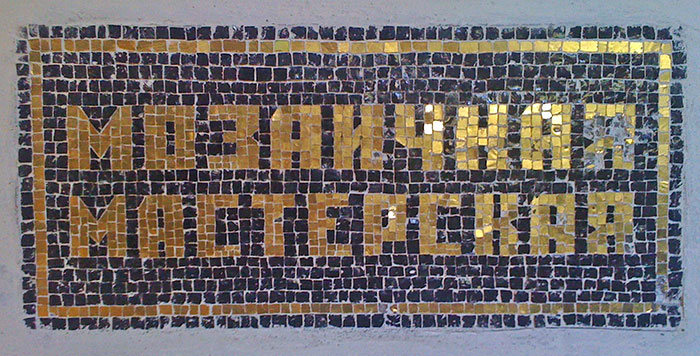
I did not have a camera with me there, so I took pictures with an iron.
Finished mosaics, not-quite-finished mosaics, and reproductions are set up everywhere. In some places there is a very, very thick layer of dust. In others, not so thick. Dim light.
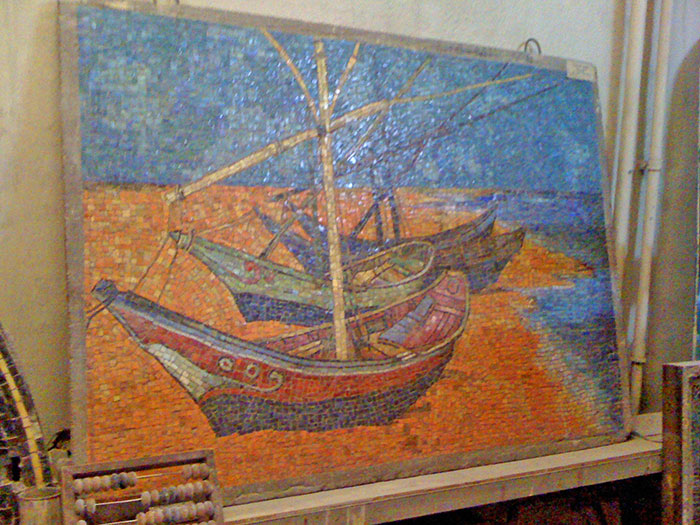
For example, in the entryway there is a mosaic based on a Van Gogh painting; bright and colorful, but also covered with a good layer of dust.
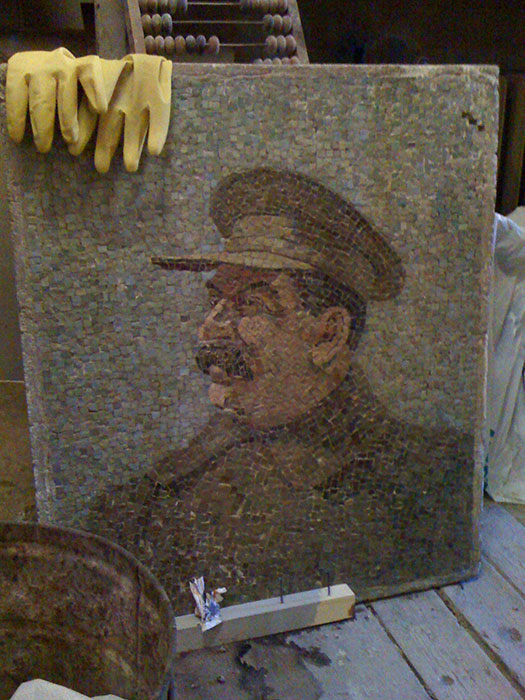
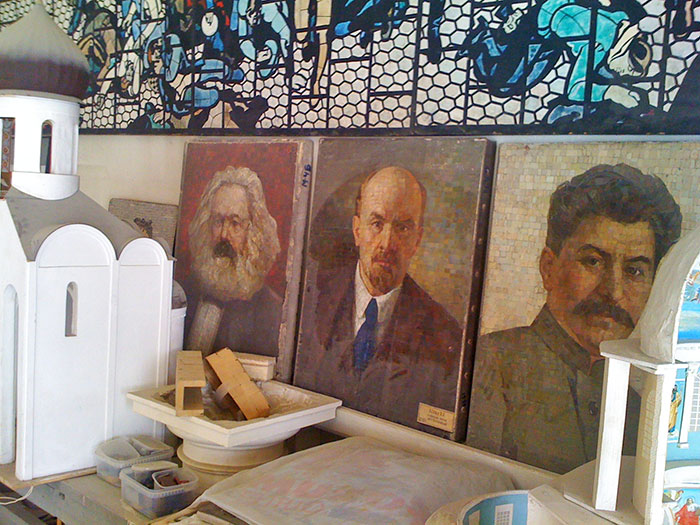
Gloves are drying on Stalin. A large trash bin stands nearby.
The process of creating a mosaic.
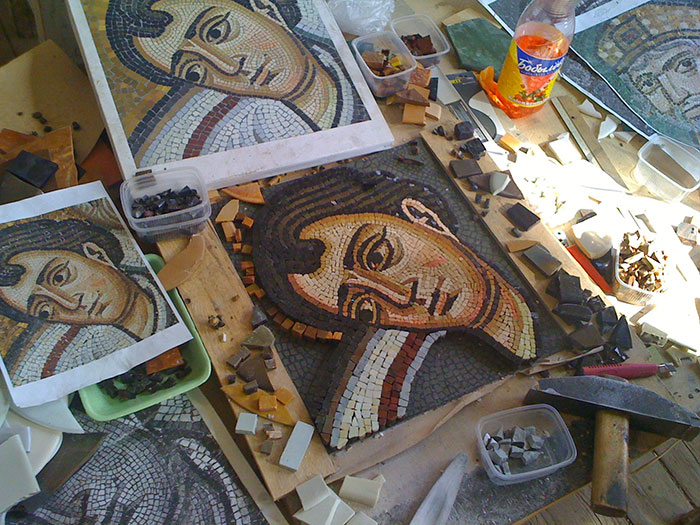
First they draw it on paper. Then they choose the colors. They split the little stones with this very hammer. They lay them onto a plasticine base. When everything is laid out, they cover the top with something, turn the picture upside down, scrape out all the plasticine, pour in cement, wait until it sets, turn it back over, and wash off the coating. That is it.
That was some Greek guy.
Here are some more Greek guys for you.
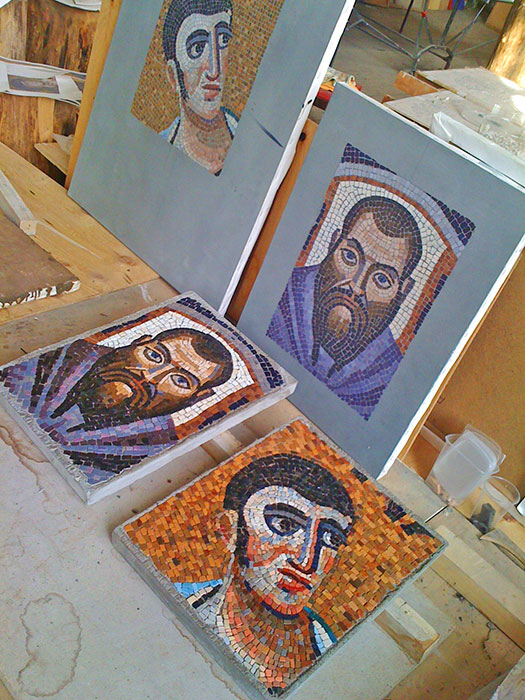
The previous photo shows finished mosaics.
Before becoming little stones, smalt is melted in a special way in a furnace. It is made from glass with the addition of some chemicals. Transparent pieces can be made too; those are used for stained glass. This workshop makes stained glass as well. Round pieces of smalt are called pancakes.
Here is this kind of rainbow. It looks very striking against all the other dust in the room.
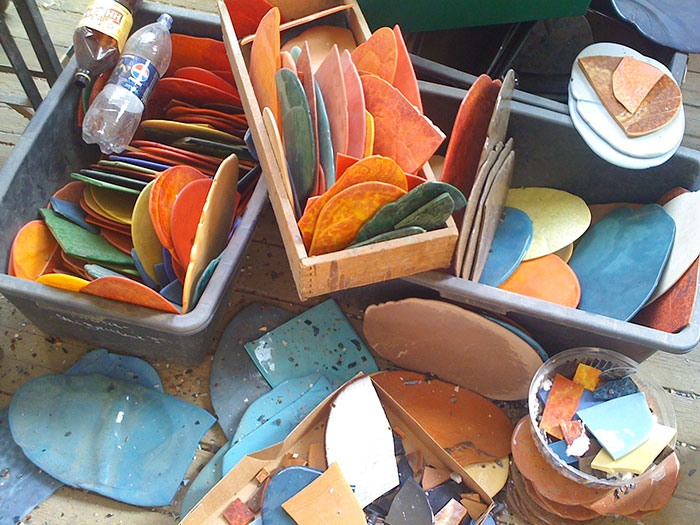
They make smalt right there. But sometimes they have to buy it. It is expensive and measured by the kilogram.
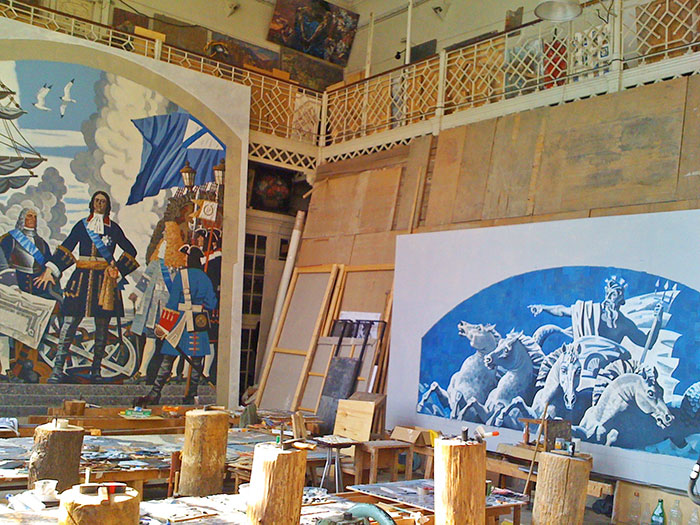
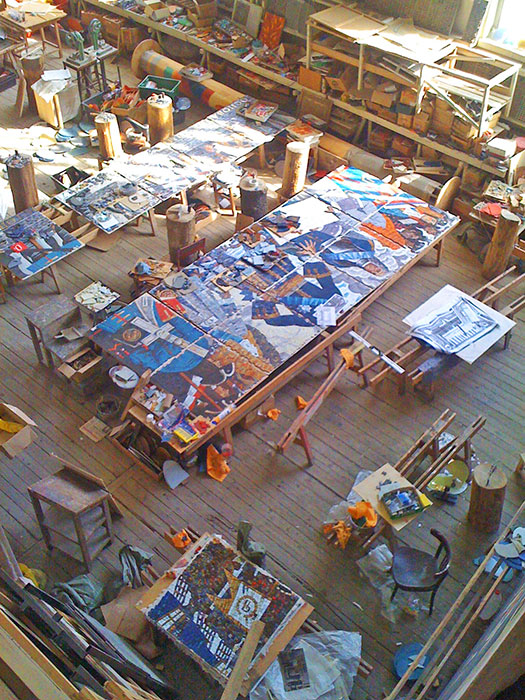
The studio has eight-meter ceilings, though I did not measure them. A balcony runs around the whole perimeter, except for the side where the window takes up the entire wall. They climb up to look at the mosaic in progress from above, because inaccuracies are easier to see that way.
The little stones are split with the hammer mentioned above on those chopping blocks. There are also all kinds of more mechanized tools, like ordinary and oil glass cutters, special hammers, and electric cutting things.
In the photo below you can see two sketches that we will apparently soon see at one of the metro stations. There was also a third picture, with a place for a clock, but it was all blocked off and I will not post it. It seems the sketch from which a mosaic is made is called a cartoon.
This is what the workshop looks like from the balcony; an incredibly beautiful metal spiral staircase leads up to it.
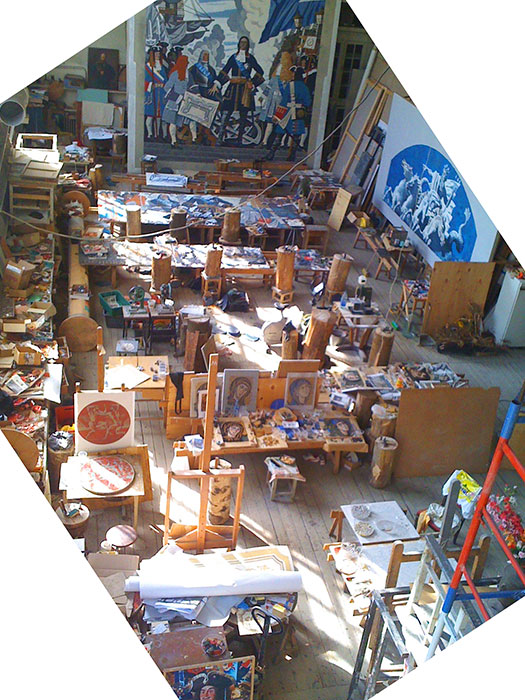
The balcony is a museum within a museum. All the walls are lined and hung with many works, mostly finished ones.
Behind the Trinity, many will recognize the stained glass from Gostiny Dvor. More precisely, the other way around: the stained glass there came from here. Several models of churches have been assembled and painted inside. It seems such models are shown before receiving approval from whoever it is; I do not know.
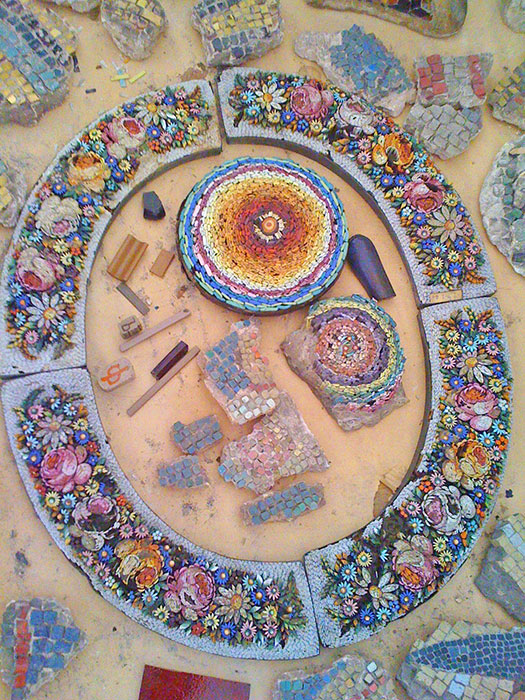
The next mosaic is completely mind-blowing. The stones are about one by two millimeters. Some are probably even smaller. A different technique is used here. I did not remember how they do it; I was too impressed by what I saw, staring at the flowers and hearing nothing around me.
Here is a fragment.
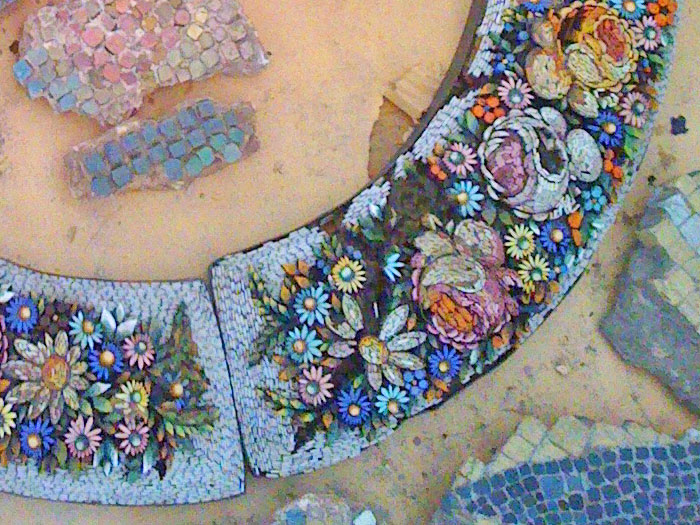
The only unclear thing is why this is lying on a balcony in a dusty workshop and not in the Hermitage. Though perhaps the masters peek at it to see how it should be done.
I kept rotating the picture in Photoshop and still could not figure out how to turn it so that everything would not be upside down.
The picture shows assembled fragments of a mosaic for the metro, made from the sketch in one of the photos above. They are roughly one meter by one meter. Later they will be taken away and attached to the wall, and the seams between fragments will be filled in directly at the station. In the end it will become a single composition.
That is all from me. Thank you for your attention :)