The Breakthrough of the Siege of Leningrad Diorama Museum
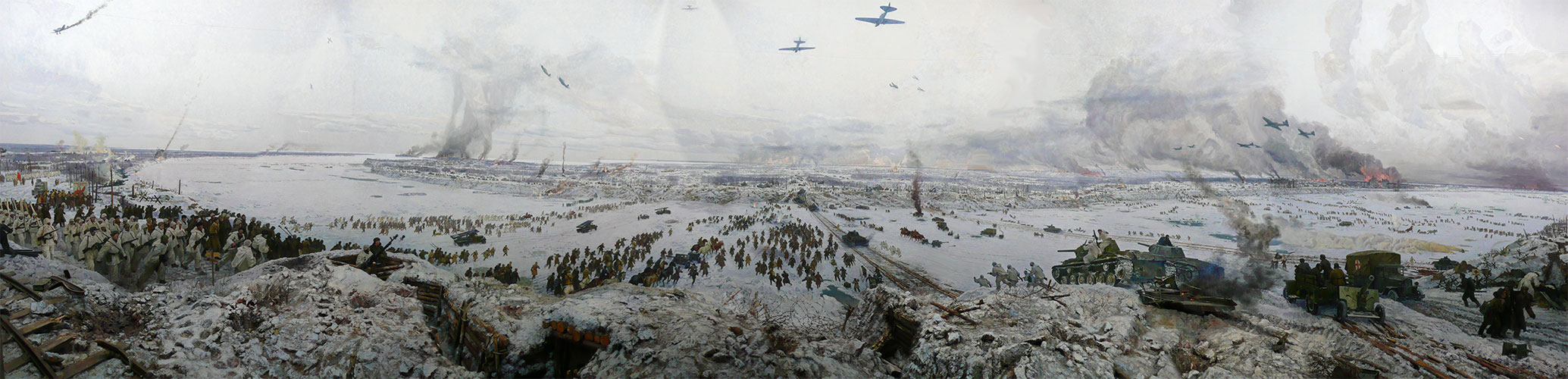
I had wanted to see this diorama for a long time. We stopped there on the way from Staraya Ladoga. The composition is very impressive. There is a scrollbar under the photo, so you can move it around.
The Breakthrough of the Siege of Leningrad Diorama Museum opened on May 7, 1985. Leningrad artists, many of whom had taken part in the defense of Leningrad, worked for more than three years on this artistic documentary canvas. The physical foreground was made by a group of model makers led by V. D. Zaitsev. Serious work was also done by military consultants: candidate of historical sciences V. P. Zaitsev and veterans of the breakthrough D. K. Zherebov and I. I. Solomakhin.
The diorama is dedicated to Operation Iskra, a turning point in the Battle of Leningrad. The multi-layered painted canvas, 40 by 8 meters, depicts for the first time the events of seven days of fierce fighting from January 12 to 18, 1943. The general idea of the operation was to defeat, with converging strikes by two fronts, the German forces holding the Shlisselburg-Sinyavino salient. The Leningrad Front struck from the west and the Volkhov Front from the east. Command of the fronts was entrusted to Lieutenant General L. A. Govorov and Army General K. A. Meretskov; representatives of Stavka, Army General G. K. Zhukov and Marshal K. E. Voroshilov, coordinated their interaction.
From the viewing platform there is a panorama of the salient, whose depth did not exceed sixteen kilometers. The museum visitor is placed in the thick of the events, on the right bank of the Neva. From here, on the morning of January 12, 1943, the 67th Army of the Leningrad Front under General M. P. Dukhanov went on the offensive. At the same time the 2nd Shock Army and the 8th Army of the Volkhov Front moved toward it under Generals V. Z. Romanovsky and F. N. Starikov. The left part of the diorama, in the foreground, mostly shows the first hours: the order is read out, a powerful artillery preparation begins, and a brass band sends the first-echelon rifle divisions into battle.
On the left flank of the offensive, Shlisselburg is engulfed in flames. In the hard fighting to liberate it, along with battalions of the 86th Rifle Division under Colonel V. A. Trubachev, the defenders of the Oreshek fortress also took part.
In the central part of the diorama, in the direction of the main strike near the village of Maryino, units of the 136th Rifle Division under General N. P. Simonyak are crossing the Neva. The diorama also shows events from the third day of fighting, when two tank brigades, the 152nd and 220th, crossed the river over timber-and-ice crossings. The modern Ladoga Bridge now stands on the site of the central crossing; the diorama museum is located in its left-bank abutment. On the right flank of the offensive, on the northern edge of the 2nd Workers' Settlement, now Kirovsk, the 268th Rifle Division under Colonel S. N. Borshchev repels fierce enemy counterattacks. In the depth you can see the legendary Nevsky Pyatachok, from which regiments of the 45th Guards Division under General A. A. Krasnov make one assault attempt after another against the 8th State District Power Plant.
At the center of the diorama, in the middle ground, is the long-awaited meeting of the Volkhov and Leningrad Fronts' shock groups, which took place on January 18, 1943 in the 1st and 5th Workers' Settlements. The blockade was broken! By February 7, 1943, a railway from Polyany to Shlisselburg, with a bridge crossing over the Neva, had already been laid across the liberated territory. Known by the people as the Road of Victory, it made it possible to build up forces for the liberation of the Leningrad land from the German occupiers in January 1944. The diorama is the architectural and artistic center of the Breakthrough of the Siege of Leningrad museum preserve, which unites memorials and monuments to the heroic defenders of the city located in the Kirovsky District of Leningrad Oblast.
Oreshek Fortress
After visiting the diorama, we went to the fortress.
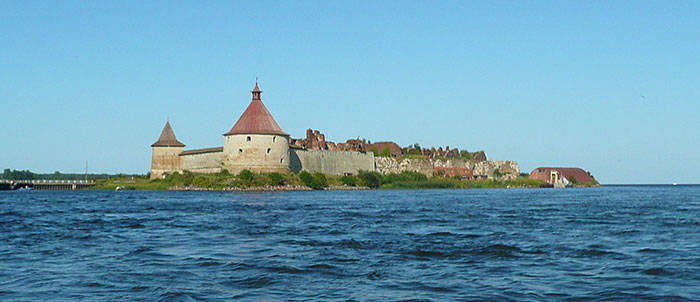
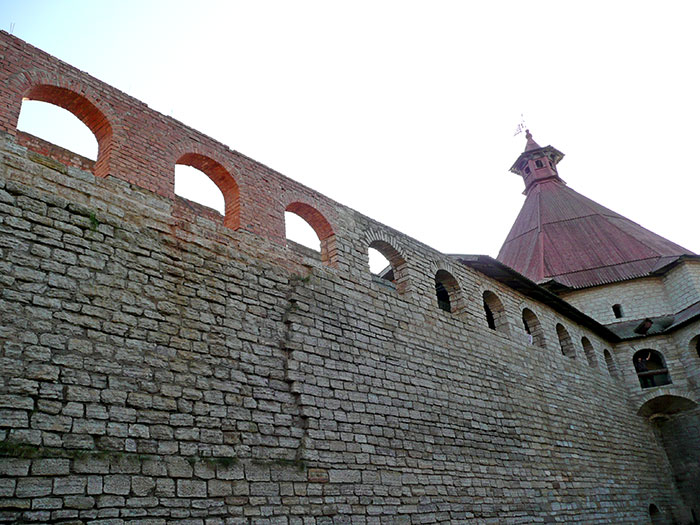
Since the previous visit, a lot had changed. Back then they did not charge money to visit the fortress itself. Moreover, there was not even anyone there to take money. Now admission costs 160 rubles. At the same time, climbing around the fortress walls, the most interesting part, yes, is not allowed: one exit to the wall is closed and wrapped in barbed wire; the second will be closed soon. The fortress is being rebuilt, for some reason, by our friends from southern countries.
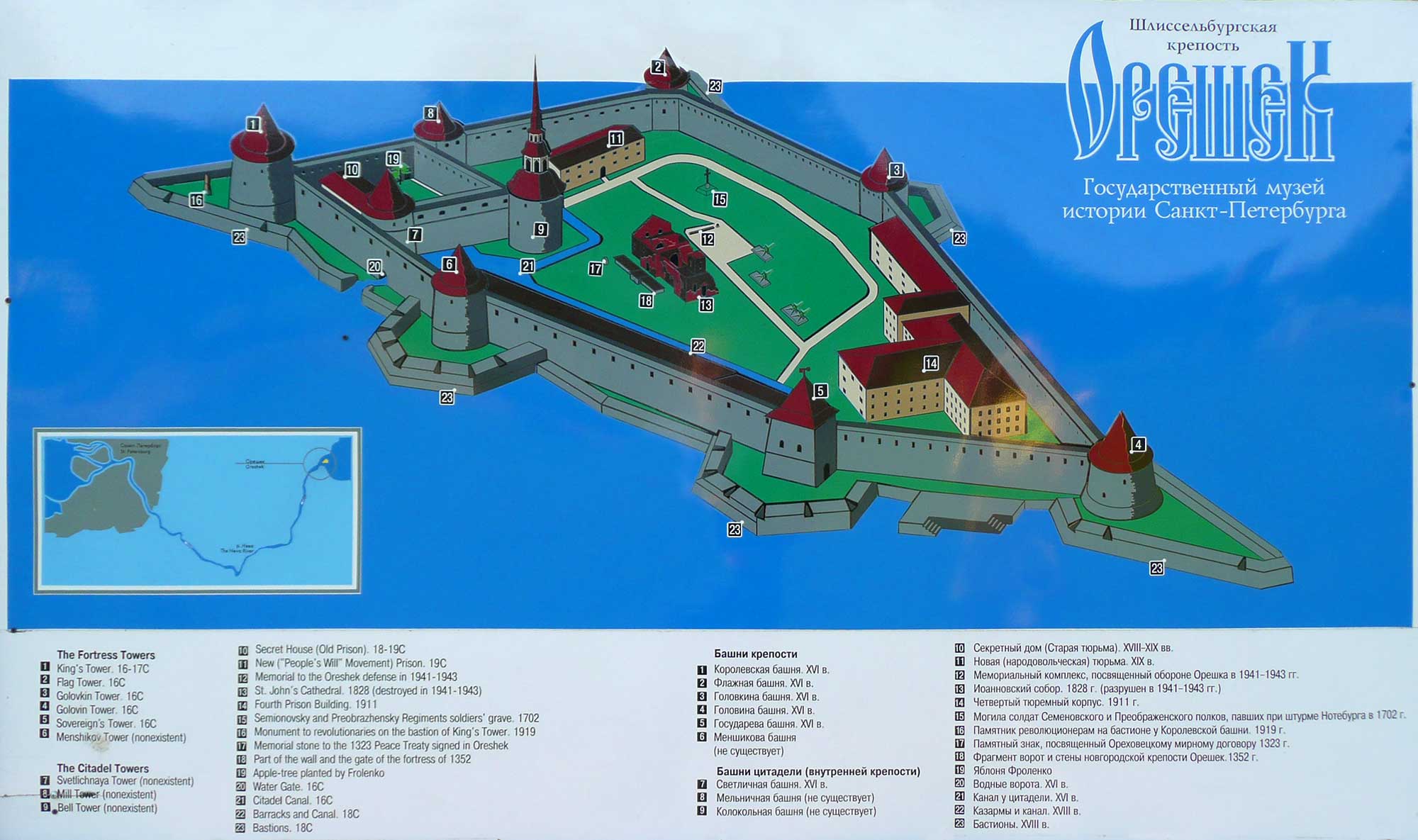
And let this fortress plan stay here too. The link opens a larger picture.